
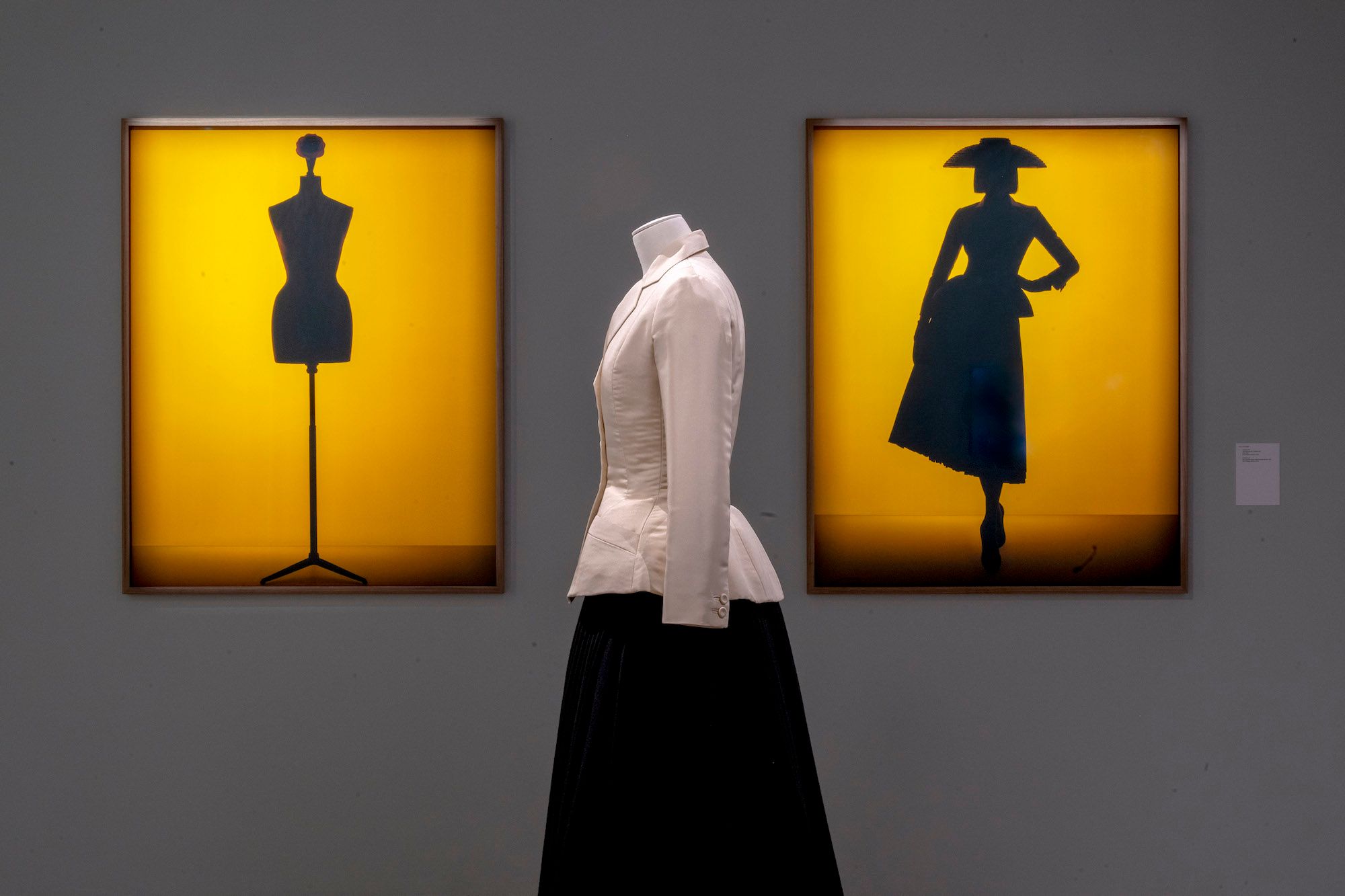

Does haute couture still have a place in the present? According to the UBS House of Craft x Dior exhibition that has opened in Singapore, the answer is: oui.
Presented at the New Art Museum from 21 to 23 November, the fashion exhibition spotlights Dior’s legacy in the rarefied world of haute couture. At the heart of the UBS House of Craft x Dior exhibition is a collaboration between French fashion editor Carine Roitfeld, who curated the exhibition, and photographer Brigitte Niedermair. Niedermair captured a series of photographs featuring legendary designs from Dior’s archives, selected by Roitfeld. That includes the Bar suit from Christian Dior’s Spring/Summer 1947 haute couture collection, which gave rise to the “New Look” that revolutionised fashion in the 20th century.
“In curating this exhibition, I wanted to create moments that feel immediate,” says Roitfeld, who is the founder and editor-in-chief of CR Fashion Book. “That meant mixing eras in unexpected ways, like pairing an archival Christian Dior jacket with a John Galliano gown.”
“It’s a way of showing how each creative director has built on Monsieur Dior’s vision, adding their own perspective while staying true to the same language of femininity, structure, and craftsmanship,” she continues. “I wanted the exhibition to capture that ongoing conversation, while showcasing Dior’s timeless identity and devotion to craftsmanship.”

UBS House of Craft x Dior shines a light on each of the French fashion house’s creative directors from over the last 80 years: Christian Dior, Yves Saint Laurent, Marc Bohan, Gianfranco Ferré, John Galliano, Raf Simons and Maria Grazia Chiuri. Roitfeld also featured a look from Kim Jones’s final Dior Men collection.
“I’ve had the privilege of meeting every Dior creative director since Gianfranco Ferré and watching the house evolve up close,” shares Roitfeld. “When working with archives that span eight decades, I kept asking myself what truly lasts beyond nostalgia. I was drawn to garments that still speak to modern women today, pieces that feel wearable, adaptable and alive.”
Roitfeld’s bold and edgy styling, which defined Vogue Paris during her decade-long tenure as the magazine’s editor-in-chief, is unmistakable: across Niedermair’s photographs, Dior’s historic haute couture creations are paired with latex gloves, fishnet tights and denim.
“Carine’s personal touch really comes through in this exhibition,” says Niedermair, who has collaborated with Roitfeld and photographed for Dior for over a decade. “She has a way of reimagining iconic Dior pieces, giving them a fresh, modern energy. She brings the archive to life, making it feel present, relevant, and full of new possibilities.”
On top of Niedermair’s photography, the UBS House of Craft x Dior exhibition also offers visitors a closer look at Dior’s craftsmanship via archival sketches and photographs, as well as actual haute couture creations from the maison, including the aforementioned Dior Bar suit.
Over the weekend, visitors can also attend talks from the likes of Roitfeld, Niedermair and Perrine Scherrer, director of Dior Heritage; or watch live craft demonstrations from Dior’s master artisans.

The UBS House of Craft x Dior exhibition was first unveiled in New York earlier this year. For its Asian debut, the exhibition has been expanded to include new photographs from Niedermair, as well as archival materials that highlights Dior’s connection with Asia—like sketches of a dress named “Nuit de Singapour”, by Yves Saint Laurent.
Singapore was specially chosen for the exhibition’s Asian debut because of the country’s status as a “global metropolis rich in culture and history,” says Jin Yee Young, co-head of UBS Global Wealth Management Asia Pacific and country head of UBS Singapore.
“Singapore’s intersection of heritage and innovation provides a distinctive backdrop for celebrating craftsmanship at the highest level, sparking dialogue and discovery,” she adds. “We are delighted to partner with Dior and Carine Roitfeld to present the expanded exhibition, paying homage to the heritage of Dior and UBS as well as showcasing the precision, dedication, and artistry that define our own craft.”
Ahead, Roitfeld and Niedermair tell GRAZIA Singapore more about how the exhibition came together.
Carine, you had the very rare opportunity to look through the Dior archives in Paris. What was that experience like?
Carine Roitfeld (CR): Visiting the Dior archives in Paris was incredibly eye-opening. It felt a bit like walking into a living museum. Every garment is treated with such respect that you can almost feel the weight of Dior’s history in the room. I discovered so many fascinating details I’d never known. For example, the origins of the Lady Dior bag trace back to Gianfranco Ferré, and finding pieces like that change how you see the evolution of the brand. What also stayed with me was the incredible attention to care: the temperature control, the custom mounts, the delicate way each garment is stored. It reminded me that couture is not just about beauty or design, but also about preservation and respect for the craftsmanship that has defined Dior over the decades.
In the exhibition, you featured the original Dior Bar Ensemble from 1947. What did it feel like to encounter a piece of fashion history?
CR: Seeing it in person, you can feel the power of the silhouette, from its nipped waist and voluminous skirt. It is remarkable how a single design has become such an enduring symbol of the house, continuing to inspire every creative director who follows. For the Singapore edition of UBS House of Craft x Dior, we created a room dedicated to Christian Dior himself, showcasing his sketches and original designs. I wanted visitors to see where it all began, to understand how his vision continues to shape the house today and how every reinterpretation is part of that ongoing story.
You also featured a red gown by John Galliano from Dior’s Fall/Winter 2004 haute couture collection. Why did you choose this particular gown?
CR: The couture dresses of John Galliano are unique and this red evening dress caught my eye. I love its scale and drama. For the photograph we created for the exhibition, we worked with Lindsey Wixson, one of the models who worked closely with Galliano during his time at Dior. To reimagine the gown while respecting its history, we paired it with Monsieur Dior’s first classic Bar jacket instead of the original corset top. Seeing these two pieces together, past and present, made so much sense. It’s a reminder that Dior is bigger than any one designer and that tradition and innovation can coexist beautifully. Watching Lindsey move and pose in the look was like seeing Galliano’s vision come alive on the runway again.

Dior has been helmed by several distinguished designers. What do you appreciate about each of them?
CR: Christian Dior was a genius. People loved him not just for his name, but for his vision of how to dress a woman, creating elegance that felt natural, beautiful, and empowering. Over the years, I’ve had the chance to meet and work with many of the creative directors who followed him, and each brought something unique to the house while staying true to that original vision. Yves Saint Laurent embodied elegance through his creations. Marc Bohan brought a quiet, effortless chic that helped shape Dior’s identity. Gianfranco Ferré has always impressed me with his precision and refinement, while John Galliano’s couture was always full of imagination, often inspired by his travels to Egypt, China, and Japan. Raf Simons showed how challenging simplicity can be, achieving perfection through minimalism, and Maria Grazia Chiuri introduced a modern, streetwise energy, pairing classic pieces like the Bar jacket with casual elements to make them feel contemporary. What ties them all together is a deep respect for Dior’s heritage combined with their own personal mark. That balance between tradition and innovation is what keeps the house timeless.
Which era of Dior do you wish more people knew about and why?
CR: If I had to choose one, it would be Marc Bohan’s. Not just because he helmed Dior for so many years, but because his work still feels remarkably modern today. I was genuinely struck by how wearable his designs are. One piece in particular, a leopard-print look from the archives, felt like it could sit on a boutique rack this season. To me, it’s proof of how truly great design can transcend time.
If you could own a single look that you featured in the exhibition, which would it be and why?
CR: It’s hard to pick just one, but I’m especially drawn to a black and pink dress inspired by Jackson Pollock and designed by Marc Bohan. Even today, it feels so fresh and modern. To me, it really shows how ahead of its time some of these designs were, combining artistic inspiration with timeless couture.

What was the most exciting thing about this project for you?
CR: What thrilled me the most was the chance to bring together all seven of Dior’s creative directors, alongside presenting a special tribute to Kim Jones, for the first time in the maison’s history. It was a once-in-a-lifetime opportunity to explore the archives and see how each designer reinterpreted Dior’s essence while staying true to its house codes. Beyond the historical significance, what moved me was the way fashion and emotion come together. This project isn’t just a retrospective of garments and images. It’s a reflection on the dedication to excellence, craftsmanship, and storytelling. Styling emblematic looks directly from Dior’s archives felt like holding fragments of living history. My role was to give them new life through a contemporary lens, reimagining the past not as nostalgia but as something vital and alive today.
In terms of its haute couture and craftsmanship, what do you think sets Dior apart from other fashion houses?
CR: Dior embodies the spirit of French couture. There’s an integrity to its craftsmanship and obsession with detail that feels timeless. Monsieur Dior founded the house on three pillars: structure, femininity, and elegance. Every designer who has followed has interpreted those ideals in their own way, yet the DNA of Dior remains unmistakable. What sets Dior apart is how deeply it respects its craft. Haute couture here is not just about luxury but about honoring the artisans that create it and the passage of time. That care and dedication is why even archival pieces still feel fresh and modern.
Given that you’ve just done a deep dive into Dior’s history, what do you think lies in its future? Do you think Jonathan Anderson shares similarities with Dior’s previous creative directors?
CR: Looking at Jonathan Anderson’s work for Dior, I see a clear connection to the house’s heritage. He continually explores femininity, often through the way he shapes the waistline, which has always been such a defining element of Dior’s silhouettes. Every designer brings their own interpretation, and Jonathan’s preference for a slightly higher waist feels like his personal signature while still honoring the core vision of Dior. It shows that the house can evolve and feel contemporary, yet remain deeply rooted in the elegance and structure that have defined it for decades.
As a fashion editor, how did you get to express your creativity differently when curating an exhibition, compared to working on a magazine?
CR: I embrace my multifaceted roles as a stylist, editor, and curator. In a way, curating UBS House of Craft x Dior was similar to composing a magazine, because both are about telling a story. The difference is that in an exhibition, the story isn’t on a page. Instead, you can move through it, you experience it in space and scale. In a magazine, I may be framing images but in an exhibition, I’m framing moments and feelings, creating a journey that people can step into and connect with.

You’ve collaborated with Brigitte Niedermair for many years. What do you appreciate about her photography and style of working?
CR: I’ve been collaborating with Brigitte for over a decade, going back to her work on CR Fashion Book. Over the years, we’ve developed a shared vocabulary and an intuition for scale, light, and proportion. She’s incredibly precise and conceptually disciplined. On set, she already knows the frame she wants and the mood she’s chasing. The moment the garment and model are in place, the photograph almost creates itself.
Brigitte, you’ve worked with Dior for over a decade. What do you try to capture in your images for the maison?
Brigitte Niedermair (BN): Over the years working with Dior, I’ve come to see its designs not as isolated pieces, but they exist as part of a continuous conversation across time. Each creative director brings their own perspective, but the essence of Monsieur Dior’s founding vision remains at the core of the house. For me, photographing for the maison is about tracing that invisible thread. I often say I feel a connection to Monsieur Dior. While he is no longer here, I sense the energy and intent behind his creations, and I strive to channel that in every image I make. My aim is to honor Dior’s legacy while making it feel immediate and alive, showing how silhouettes from decades past can still speak to us today. In this way, every photograph becomes a bridge between tradition and the present, reflecting the enduring essence of Dior’s timeless elegance and heritage.
Your campaigns for Dior tend to feature close-up shots that focus on the details of the garments. What fascinates you about the craftsmanship at Dior?
BN: Couture is inherently three-dimensional. It’s meant to move, to be touched, and to exist in space around a body. What fascinates me is how that sense of volume and life is present in every seam, fold, and stitch. Even the smallest detail carries intention and precision. To translate that into photography is challenging. I lean into light, texture, and framing to bring out the garment’s inner architecture. The craftsmanship, when seen up close, becomes a conversation between the designer, the artisan, and the viewer. It’s how I try to show that behind every beautiful garment are the imaginative minds and skilled hands that brought it to life.

How would you describe your creative relationship with Carine Roitfeld over the years?
BN: Carine and I share a long creative history spanning more than a decade and multiple projects, built on a foundation of trust and mutual respect. She brings instinct and intuition, often sensing the mood or energy of a moment first, while I focus on structure, composition, and light. On set, our different strengths feed off each other. Her spontaneous ideas inspire me to see possibilities I might not have considered, and my precision helps bring those ideas to life in a clear way. Working together on UBS House of Craft x Dior has allowed us to challenge and elevate each other, producing work that brings our two sensibilities into dialogue for a greater purpose.
Which is the most memorable photograph that you got to create for this exhibition?
BN: One photograph I’ll always return to shows a model standing against a grey backdrop, wearing a pale pink structured dress with hundreds of hand-appliquéd flowers on the skirt and bodice, and a jean jacket draped halfway up her arms. At first, it’s the elegance of the silhouette and the detail of the garments that draws you in. But when you look closer, there are subtle details like a tiny image of Monsieur Dior above her head, and a nod to his sister, Catherine Dior, hidden in the shoe. This has become a favourite of mine as there’s many layers to be uncovered. Beyond showcasing the garment and its craftsmanship, it’s about connecting the house’s heritage with Monsieur Dior’s story, his life beyond his creations, and his enduring cultural presence in a single, meaningful image.
Register for the UBS House of Craft x Dior exhibition here.
READ MORE
Jonathan Anderson’s Dior Debut: What To Know About The Biggest Show Of Paris Fashion Week
Iris Van Herpen Wants To Change How You See The World
The post This Fashion Exhibition In Singapore Offers A New Look At Dior’s ‘New Look’ appeared first on Grazia Singapore.
