
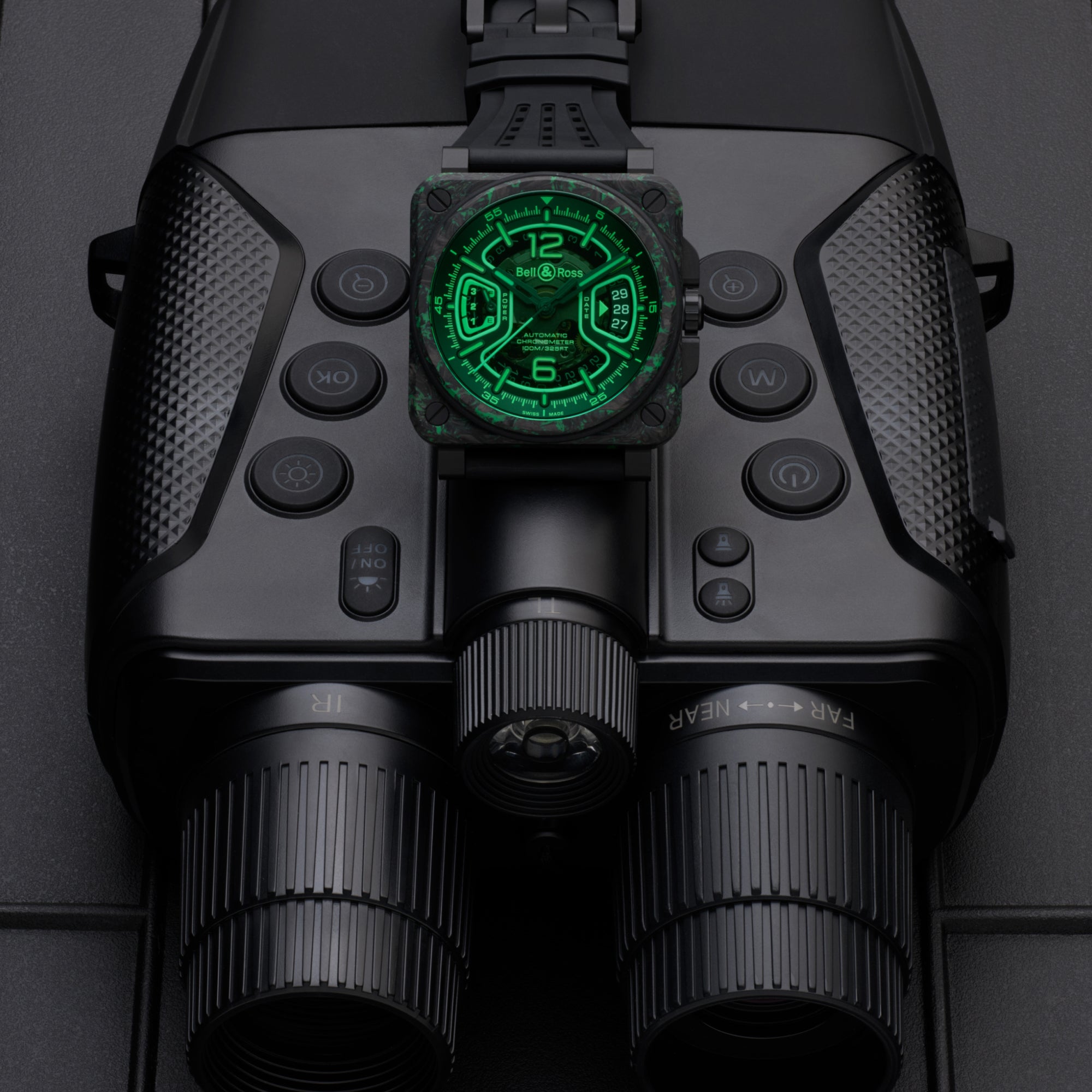

In any given issue, I struggle to decide what to filter out and where to let the chips fall as they may. Most of the time, it is not worth the column inches, as they used to say (look it up), and pictures might be a pain to find. Then I watched the Dubai Watch Week discussion between YouTube maverick and watch dealer Nico Leonard and WatchPro Editor Rob Corder… I recommend you watch this exchange if you read this because I am intent on only one point: that new watches are planned years in advance and that is somehow bad…because it might be.

Of course, this excludes special pieces like the Blancpain Grande Double Sonnerie but not only these. It could also be anything that includes a new function or case, and certainly anything with an improvement in existing basic functions, like the power reserve for example. This was certainly the case, no pun intended, with the BR-X3 and X5 series from Bell & Ross; one cannot expect something like this to emerge in just a couple of years.


Bell & Ross BR-X3
Before I get into this, most of the conversation between Leonard and Corder was not about this, and I wrote multiple responses to many different points but those all went on too long and would have filled up another entire issue. Besides, this development matter is the only succinct point that I think was a missed opportunity. Broadly speaking on the other points, it is vacuous to take apart another person’s opinion because you have a different one so I will try not to do that.
And now, why do I want to address how long brands take to develop watches? There is an honest critique to be made here, and a discussion to be had. Neither Leonard nor Corder tried that, and the line was a throwaway remark that allowed Leonard to name-drop the Tudor CEO and Corder to say that watch brands all proudly claim it takes them years to develop their watches. Now, if either of them said that brands take an ungodly number of years to produce anodyne products, that would have been saying something real. Also, a missed opportunity for both these pundits to stick it to Big Time, or whatever.

To channel Leonard a little, the late Luigi Macaluso once told me to beware the tyranny of novelty — and I have kept his words close to heart and repeated them in public frequently. This is because this magazine, and plenty of specialists including Leonard and Corder, are constantly thrashing about in the unrelenting waves of new releases. I often find that brands should reconsider their release strategies, not to jump on trends faster but to figure out which ones to maybe ignore. It would be better if not every brand had to have a watch with a certain shade of blue, to cite just one example.
But things could be worse — we could be discussing triple A video games, the vast majority of which are released more or less unfinished, and then workshopped to the grave on the public’s dime. It is a good way to make a buck and an even better way to alienate the customer. The last major watch release that I might argue came even close was the Audemars Piguet Code 11:59 at launch, which makes for a great segue. When brands launch new collections, especially the big ones that Leonard and Corder are on about, they often spend years (or claim to spend that time, but that is another story) trying to get it right. When the results are just “meh,” that is a problem. Even a bad watch is better than a “meh” one — the old Louis Vuitton Tambour was a fantastic bad watch, for example. So are any number of discontinued watches, including my favourite Rolex Prince models, just so everyone understands that I have skin in this game and that ‘bad’ is subjective.

Returning to my singular point for this story, timelines are not a useful gauge and watch brands have shown, repeatedly, that they do not need a fixed number of years to develop watches, winners or otherwise. One example we can easily cite is that of Parmigiani Fleurier, which put out its most appealing model ever, the Tonda PF, in just under a year. Even more recently, we have the example of Breguet and the slew of watches this year. While they have no doubt been in the works for a while, the arrival of a new CEO no doubt necessitated some changes. I have nothing specific to go on but it seems like common sense. Of course, we have also seen something similar at Breitling, Bremont and Montblanc, all with varying degrees of success.
Of course, there are romantic notions to consider, especially any that confirm the dream of the mechanical watch: an eternal object that will always be by one’s side. Any idea that a watch might be a product like any other needs to be quashed mercilessly. Better yet, it should never come up. As watch buyers or collectors, we do need to question whether the claimed development time is reflected in whatever watch we are considering. Typically, this only comes up when a watch sparks contention, as most famously seen in the debut of the Patek Philippe Cubitus last year.

When brands rush watches out to meet commercial expectations, the results are mixed. Once again though, I would argue that as long as the novelties are not simply forgettable, some amount of debate is useful. It is for this reason — and Leonard’s famous ranking (which includes a “Meh” category) — that I was enthused about the development point. It is also why I was subsequently disappointed. Hopefully, he will revisit this idea upon reflection because it is a rich one, as I hope this little missive shows. Perhaps I will hit Leonard up in his comments section…
This story was first seen as part of the WOW #82 Festive 2025 Issue
For more on the latest in luxury watch reads, click here.
The post Bell & Ross BR-X3 and the Reality of Watch Development Cycles appeared first on LUXUO.
